Why Startups Face Cybersecurity Risks: 2026 Guide
By TechTrone Team — Published 2026-06-15
Why Startups Face Cybersecurity Risks: 2026 Guide
Startups are prime targets for cyberattacks because they hold sensitive customer data and intellectual property from day one while frequently operating with immature security controls and no dedicated security staff. Small businesses account for 43% of cyberattacks annually, with average incident costs reaching $25,000. That number alone should reframe how founders think about security budgets. Understanding why startups face cybersecurity risks, a challenge the industry formally calls startup attack surface exposure, is the first step toward building a company that survives its growth phase. The stakes are not theoretical. 60% of small companies close within six months of a major breach.
Why startups face cybersecurity risks more than established firms
Startups attract attackers for a specific reason: the ratio of valuable data to security maturity is extremely favorable for criminals. A Series A company may already process payment data, health records, or proprietary algorithms, yet its security posture often resembles a five-person team sharing admin passwords. Attackers exploit default configurations and weak credential hygiene because these shortcuts are predictable and easy to automate.
Leadership bias compounds this problem significantly. Many founders genuinely believe their company is too small or too obscure to attract criminal attention. This misconception is dangerous because automated scanning tools do not discriminate by company size. Attackers run scripts that probe millions of IP addresses simultaneously, flagging any exposed cloud storage bucket or unpatched login portal regardless of the company behind it.

Limited dedicated security staff is the third structural factor. Most early-stage startups assign security responsibilities to a developer or operations generalist who already carries a full workload. Without a dedicated owner, threat detection slows, patches get delayed, and incident response plans never get written. The result is a compounding vulnerability that grows faster than the company itself.
What cybersecurity threats commonly target startups
The threat categories hitting startups hardest are not exotic. They are well-documented, frequently automated, and specifically calibrated to exploit the gaps that young companies leave open.
The five most damaging threats for startups are:
-
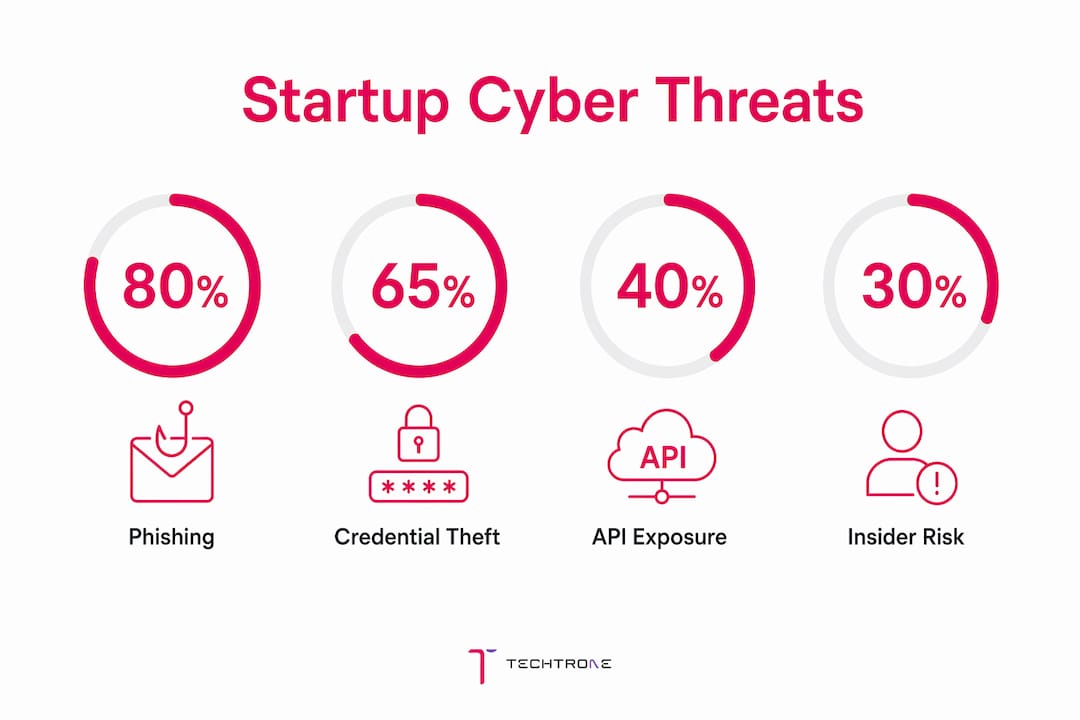
Phishing attacks. Phishing initiates 80 to 95% of breaches involving human factors. Employees at smaller companies receive proportionally more malicious emails because attackers know smaller teams have less security training and fewer email filtering tools in place.
-
Ransomware. Ransomware locks critical systems and demands payment before restoring access. For a startup with no backup strategy, a single ransomware event can halt operations entirely for days or weeks.
-
Credential theft. Shared admin passwords and reused credentials across platforms mean a single stolen login can expose every system the company runs. This is not a rare edge case. It is a standard attack path.
-
Supply chain attacks. Startups often connect to larger enterprise clients through APIs and integrations. Attackers use a startup’s weaker defenses as an entry point to reach those larger targets, making the startup both a victim and an unwitting accomplice.
-
Exposed cloud infrastructure. Misconfigured AWS S3 buckets, open database ports, and publicly accessible development environments are common in fast-moving teams. Automated scanners find these within hours of deployment.
Pro Tip: Use tools like GitGuardian or Trufflehog to scan your code repositories for accidentally committed API keys, passwords, and tokens before they reach production. Secrets in public or semi-public repositories are exploited within minutes of exposure.
Understanding the full range of cybersecurity threats businesses face helps founders prioritize which gaps to close first.
How organizational factors inside startups increase cyber risk
The technical vulnerabilities are real, but the deeper problem is structural. Cyber risk management fails most often due to governance gaps rather than purely technical failures. Accountability, policy ownership, and incident response readiness are organizational decisions, not software purchases.
Here is how internal startup dynamics create compounding security exposure:
-
Deprioritized security spending. Founders allocate budget toward product development and customer acquisition. Security feels like overhead until a breach makes it feel like survival.
-
Default insecure configurations. Cloud platforms, SaaS tools, and development environments ship with permissive default settings. Teams that never harden these defaults leave predictable attack surfaces open indefinitely.
-
Shared admin credentials. When three engineers share one admin password for a production database, there is no audit trail, no way to revoke individual access, and no way to know who did what when something goes wrong.
-
No incident response plan. Most early-stage startups have never written down what to do when a breach occurs. The first hour of a breach is the most critical for containment, and improvising it costs time, data, and money.
-
Security debt accumulation. Security debt from loose credential practices compounds as startups scale. What starts as a temporary shortcut becomes an entrenched habit that is exponentially harder to fix at 50 employees than at five.
CISA’s Cybersecurity Performance Goals 2.0 (CPG 2.0) provides a practical baseline framework that startups can adopt without a dedicated security team. It covers asset inventory, multi-factor authentication (MFA), basic logging, and incident response planning. These are not enterprise-grade requirements. They are minimum viable security practices that any startup can implement in weeks.
Pro Tip: Assign a named security owner for each critical system, even if that person is a developer with other responsibilities. Clear ownership prevents the “someone else will handle it” failure mode that leaves vulnerabilities unaddressed for months.
Reviewing cybersecurity best practices for SMBs gives founders a concrete checklist to work from without requiring a full security team.
Why the early-stage risk window is the most dangerous period
The period between acquiring your first paying customers and achieving formal compliance certification is the highest-risk window a startup will ever face. This 12 to 18 month phase combines real customer data, real financial transactions, and real intellectual property with security practices that are still informal and largely untested.
The table below maps how risk factors shift across startup stages:
| Stage | Data exposure | Security maturity | Primary risk |
|---|---|---|---|
| Pre-seed | Minimal customer data | Very low, mostly defaults | Exposed dev environments |
| Seed | Early customer and payment data | Low, ad hoc practices | Phishing, credential theft |
| Series A | Full customer data, integrations | Moderate, still informal | Supply chain, ransomware |
| Series B+ | Enterprise data, compliance scope | Growing, formalized | Insider threats, advanced attacks |
Rapid growth amplifies every risk in this table. Each new product integration, remote employee, and third-party vendor expands the attack surface. Attackers actively scan for exposed cloud infrastructure and misconfigured services, and a startup that deploys quickly without security review creates new entry points faster than it can close old ones.
The cost dimension matters here. Security fixes become exponentially costlier when delayed beyond early stages. Remediating a credential management problem across 10 systems at five employees takes a day. Doing the same across 80 systems at 60 employees, with multiple product lines and enterprise client contracts in scope, takes weeks and may require external consultants.
Credential leakage from developer shortcuts is one of the most common and costly early-stage incidents. Secrets committed to code repositories are exploited within minutes by automated scanners. A single leaked API key can give an attacker full access to a cloud environment, a customer database, or a payment processing account.
How startups can reduce cybersecurity risks without slowing growth
Building security into a startup does not require a large budget or a dedicated security team. It requires deliberate habits, clear ownership, and a few non-negotiable technical controls implemented early.
The most effective starting points are:
-
Implement MFA everywhere. Multi-factor authentication on email, cloud platforms, code repositories, and admin consoles stops the majority of credential-based attacks. Tools like Duo Security, Google Authenticator, and Microsoft Authenticator are free or low-cost and take hours to deploy.
-
Use a password manager. Platforms like 1Password or Bitwarden eliminate shared passwords and give every team member unique, strong credentials for every system. This single change addresses one of the most common startup vulnerabilities.
-
Conduct a cybersecurity risk assessment. A structured risk assessment for SMBs identifies your highest-priority exposures before attackers find them. You do not need to fix everything at once. You need to know what matters most.
-
Scan for secrets continuously. Integrate automated secret scanning into your CI/CD pipeline using tools like GitGuardian. Continuous credential rotation and scanning are necessary practices, not optional ones, for any team that writes code.
-
Write a basic incident response plan. Document who gets called, what systems get isolated, and how customers get notified if a breach occurs. A one-page plan written today is worth more than a perfect plan written after an incident.
-
Leverage managed IT services. Affordable managed security providers give startups access to 24/7 monitoring, threat detection, and incident response expertise without the cost of full-time security hires.
Pro Tip: Treat your first security audit the same way you treat your first legal review. Do it before you think you need it, not after something goes wrong. The cost of prevention is a fraction of the cost of response.
Understanding why cyber insurance matters is also worth your time, since even well-protected startups benefit from financial coverage when incidents occur.
Key takeaways
Startups face elevated cybersecurity risks because they combine high-value data with immature controls, limited staff, and rapid growth that outpaces security investment.
| Point | Details |
|---|---|
| Startups are high-value targets | Sensitive data and weak defenses make startups attractive to automated attacks regardless of company size. |
| The 12 to 18 month window is critical | The phase between first customers and formal compliance carries the highest risk and the lowest security maturity. |
| Governance gaps drive most failures | Shared credentials, no incident plans, and unclear ownership create more risk than technical vulnerabilities alone. |
| Security debt compounds fast | Shortcuts taken at five employees become expensive, complex problems to fix at fifty. |
| Early action is the cheapest option | MFA, password managers, and basic incident planning cost little but prevent the majority of common attacks. |
Techtrone’s take on startup security culture
After working with dozens of growing businesses, the pattern is consistent: founders who treat security as a cultural value from day one build companies that survive incidents. Founders who treat it as a compliance checkbox deal with the consequences later, usually at the worst possible time.
The misconception I see most often is the belief that attackers are selective. They are not. The tools criminals use today are automated, scalable, and indifferent to how interesting your company is. If you have an exposed port, a weak password, or an unpatched system, you will be found. The question is whether you are ready when that happens.
What startups actually have over large enterprises is a genuine advantage: no legacy infrastructure to defend, no decade-old processes to unwind, and no organizational inertia blocking change. You can build security into your culture before bad habits form. That is a real competitive edge that most established companies would pay significantly to have back.
The founders who act early, even imperfectly, are the ones who avoid the breach that closes the company. Security does not have to be perfect. It has to be present.
— Techtrone
How Techtrone helps startups build security from the ground up
Startups working with Techtrone get access to managed IT and cybersecurity services designed specifically for growing businesses that need enterprise-grade protection without enterprise-level overhead.
Techtrone provides 24/7 proactive monitoring, threat detection, incident response support, and compliance guidance tailored to your stage of growth. Whether you are a seed-stage team of five or a Series A company scaling across multiple locations, Techtrone’s team acts as your dedicated security partner. You get the expertise of a full security operation without the cost of building one in-house. Explore Techtrone’s cybersecurity services or use the IT plan designer to build a security program that fits your current needs and scales with your growth.
FAQ
Why are startups targeted by cybercriminals?
Startups hold valuable data from day one but typically operate with weak defenses, default configurations, and no dedicated security staff. Automated attack tools scan for these vulnerabilities without regard for company size.
What is the most common cybersecurity threat for startups?
Phishing is the most frequent entry point, initiating 80 to 95% of breaches involving human factors. Credential theft and exposed cloud infrastructure follow closely as the next most damaging threats.
When is a startup most vulnerable to a cyberattack?
The 12 to 18 months after acquiring first customers is the highest-risk period. Real data is present, but security practices are still informal and largely untested during this phase.
How much does a cyberattack cost a startup?
Severe breaches cost small businesses an average of $3.31 million, and 60% of small companies close within six months of a major incident. Even smaller incidents average $25,000 in direct losses.
What is the first security step a startup should take?
Deploy multi-factor authentication across all critical systems immediately. MFA stops the majority of credential-based attacks and takes hours to implement using tools like Duo Security or Microsoft Authenticator.