Why Businesses Adopt Zero Trust Security in 2026
By Techtrone IT Services — Published 2026-07-06
Why Businesses Adopt Zero Trust Security in 2026
TL;DR:
- Zero Trust Security assumes no user or device should be trusted without continuous verification. Organizations adopt it mainly because traditional networks no longer protect against cloud and remote work vulnerabilities. Implementing Zero Trust improves security, compliance, and breach response by focusing on identity, micro-segmentation, and ongoing validation.
Zero Trust Security is defined as the cybersecurity model that assumes no user, device, or network connection should be trusted by default, requiring continuous verification for every access request. The industry standard governing this model is NIST SP 800-207, which establishes seven core tenets built on minimal implicit trust and real-time access evaluation. The collapse of traditional network perimeters, driven by cloud adoption, SaaS platforms, and remote work, has made the old “trust inside the firewall” approach a liability. The Zero Trust market is projected to reach $92.42 billion by 2030, growing at a compound annual rate of 16.4%, with 60% of organizations expected to adopt the model by 2025. For business leaders and IT decision-makers, understanding why businesses adopt zero trust security is no longer optional. It is a prerequisite for protecting data, meeting regulatory requirements under GDPR, HIPAA, and SOC 2, and building a security posture that holds up against modern threats.
Why do businesses adopt Zero Trust Security?
The single biggest driver is the collapse of the traditional network perimeter. When employees worked inside a corporate office on company-owned devices, a firewall at the edge made sense. Cloud platforms like Microsoft 365, remote workforces, and third-party SaaS tools have eliminated that edge entirely.

The financial stakes reinforce urgency. The average cost of a data breach now stands at $4.88 million. That figure includes incident response, legal exposure, regulatory fines, and reputational damage. No organization can absorb that kind of loss repeatedly without a structural change in how it controls access.
Regulatory pressure adds another layer of motivation. 72% of organizations cite regulatory compliance as a top driver for Zero Trust adoption. Frameworks like HIPAA, GDPR, and SOC 2 require demonstrable access controls, audit trails, and data protection mechanisms. Zero Trust maps directly to those requirements, making compliance easier to prove and cheaper to maintain.
The threat landscape itself has also changed. AI-driven cyberattacks now automate phishing and vulnerability scanning at a scale that overwhelms signature-based defenses. Identity sprawl, where users accumulate access rights across dozens of systems, creates attack surfaces that grow faster than most IT teams can manage. Insider threats, whether malicious or accidental, exploit the same implicit trust that perimeter security was built on.
Key business drivers for Zero Trust adoption include:
-
Perimeter collapse from cloud, remote work, and SaaS proliferation
-
Breach cost exposure averaging $4.88 million per incident
-
Regulatory mandates under GDPR, HIPAA, and SOC 2
-
AI-accelerated threats that bypass traditional defenses
-
Identity sprawl creating unmanaged access risk across systems
-
Insider threat exposure from over-privileged accounts
What are the core principles of the Zero Trust Security model?
The Zero Trust Security model operates on one governing principle: never trust, always verify. Every access request, regardless of where it originates, must be authenticated, authorized, and continuously validated before access is granted.
NIST SP 800-207 defines Zero Trust architecture around two key components: the Policy Decision Point (PDP), which evaluates whether access should be granted, and the Policy Enforcement Point (PEP), which executes that decision. These two components work together to ensure no session is assumed safe based on prior approval alone.
Least privilege access is the operational expression of this principle. Users and devices receive only the permissions they need for a specific task, for a specific period. Just-in-time provisioning takes this further by granting elevated access only when requested and only for the duration required. This approach directly limits the damage an attacker can do with a compromised account.
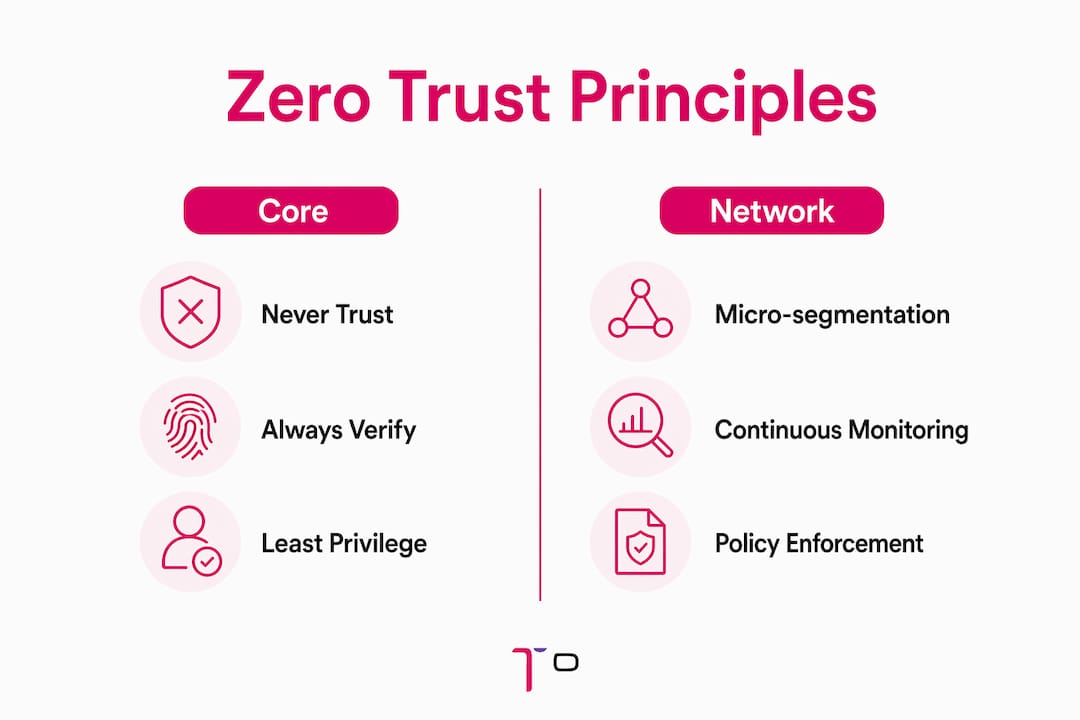
Micro-segmentation divides the network into isolated zones. If an attacker breaches one segment, they cannot move laterally to other systems without re-authenticating. This reduces the “blast radius” of any single breach and is one of the most measurable security outcomes Zero Trust delivers.
| Dimension | Traditional perimeter security | Zero Trust architecture |
|---|---|---|
| Trust model | Implicit trust inside the network | No implicit trust anywhere |
| Access control | Location-based | Identity and context-based |
| Verification | One-time at login | Continuous throughout session |
| Lateral movement | Largely unrestricted | Blocked by micro-segmentation |
| Device posture | Rarely checked | Verified before every access |
| Breach response | Detect after the fact | Assume breach, limit blast radius |
Pro Tip: Zero Trust is an architectural strategy, not a product you purchase. No single vendor delivers a complete Zero Trust environment. Align your implementation with NIST SP 800-207 and build incrementally around specific business scenarios.
What business benefits do organizations gain from Zero Trust adoption?
The most direct benefit is reduced breach impact. Zero Trust improves security orchestration, accelerates threat detection, and enables automated responses that cut incident resolution time. When a compromised credential triggers an anomaly, the system can revoke access automatically rather than waiting for a human to investigate.
Compliance outcomes improve significantly. Zero Trust controls map directly to GDPR’s data access requirements, HIPAA’s minimum necessary standard, and SOC 2’s access management criteria. Organizations that implement Zero Trust reduce their audit scope because access logs, device health records, and authentication events are already captured and centralized. That translates to lower audit preparation costs and faster certification cycles.
Long-term cost savings accumulate in ways that are not always obvious at the outset. Fewer successful breaches mean fewer incident response engagements. Tighter access controls reduce the volume of over-privileged accounts that require manual cleanup. Automated policy enforcement reduces the labor cost of access reviews.
Pro Tip: Frame your Zero Trust initiative as a compliance project when presenting to the CFO or General Counsel. Compliance-driven budget approval moves faster than abstract security investment, and the controls you build serve both goals simultaneously.
Additional business benefits include:
-
Reduced audit scope through centralized access logging and automated controls
-
Faster breach containment via automated session termination and micro-segmentation
-
Improved vendor trust as customers and partners increasingly require Zero Trust attestation
-
Lower identity risk through continuous authentication and credential monitoring
-
Better visibility across cloud, on-premises, and hybrid environments
For a detailed breakdown of Zero Trust benefits for business leaders, the business case extends well beyond IT into risk management and competitive positioning.
How can businesses implement Zero Trust Security effectively?
Zero Trust implementation succeeds when aligned with specific business scenarios and pursued incrementally. Treating it as a one-time infrastructure rebuild is the most common reason implementations stall. The following phases reflect a practical, sequential approach.
-
Harden identity and access management first. Deploy strong multi-factor authentication (MFA) across all user accounts. Implement credential monitoring to detect compromised passwords before attackers use them. 68% of breaches involve the human element, which means identity is the highest-priority control surface.
-
Enforce device health verification. Conditional access policies should check endpoint health before granting access to any corporate resource. Unmanaged or non-compliant devices must be blocked or restricted, regardless of valid credentials.
-
Apply micro-segmentation to critical systems. Start with your highest-value data environments, such as financial systems, patient records, or intellectual property repositories. Segment these from general network traffic and require re-authentication for access.
-
Implement continuous monitoring and logging. Deploy a Security Operations Center (SOC) function or a SOC service to monitor access patterns in real time. Anomaly detection must feed directly into incident response workflows.
-
Adopt the assume breach mindset. Planning incident response as if a breach has already occurred produces better outcomes than designing for perfect prevention. Define containment playbooks, test them regularly, and ensure your team knows how to isolate compromised segments without disrupting operations.
-
Align controls with regulatory requirements. Map each Zero Trust control to the specific regulation it satisfies. This creates a compliance evidence trail and justifies continued investment to executive stakeholders.
-
Partner with a managed services provider for continuous advisory. Zero Trust is not a project with a finish line. Threat landscapes shift, regulations update, and your environment changes. A managed IT partner provides the continuous oversight that internal teams often cannot sustain alone. Reviewing common network security gaps is a practical starting point before beginning implementation.
Key Takeaways
Zero Trust Security succeeds when organizations treat it as a continuous architectural strategy built on identity verification, least privilege access, and micro-segmentation rather than a one-time product deployment.
| Point | Details |
|---|---|
| Identity is the new perimeter | Harden MFA and credential monitoring before any other Zero Trust control. |
| Breach cost justifies investment | At $4.88M average per breach, Zero Trust controls deliver measurable financial protection. |
| Compliance drives budget approval | Frame Zero Trust as a GDPR, HIPAA, or SOC 2 initiative to accelerate executive funding. |
| Incremental adoption works best | Align each phase with a specific business scenario per NIST SP 800-207 guidance. |
| Assume breach, not perfect security | Build incident response playbooks alongside access controls for real-world resilience. |
Zero Trust is no longer a future investment
The shift from trusting location to trusting identity and context is the most significant change in enterprise security thinking in the past decade. When I look at how organizations approach this, the ones that succeed are not the ones with the largest budgets. They are the ones that stop treating Zero Trust as a destination and start treating it as a discipline.
The “assume breach” mindset is the part most business leaders resist. Accepting that an attacker may already be inside your network feels defeatist. It is actually the opposite. It forces you to build containment, detection, and response capabilities that make a breach survivable rather than catastrophic.
The compliance angle matters more than most security professionals admit. Tying Zero Trust controls to GDPR, HIPAA, or SOC 2 requirements does not dilute the security value. It creates organizational commitment that survives budget cycles and leadership changes. Security initiatives that cannot demonstrate regulatory relevance tend to lose funding after the first year.
The emerging threat picture makes delay increasingly costly. AI-accelerated attacks have made implicit trust a genuine liability, not just a theoretical weakness. Organizations that wait for a breach to motivate adoption pay a much higher price than those that build controls proactively. The question for business leaders is not whether to adopt Zero Trust. It is how fast you can build the identity and access foundation that everything else depends on.
— TechTrone Team
Techtrone IT Services supports your Zero Trust security journey
Techtrone IT Services works with Long Island businesses to build and maintain Zero Trust security programs that align with real operational needs. The team brings expertise in identity and access governance, device compliance enforcement, continuous monitoring, and regulatory alignment across HIPAA, GDPR, and SOC 2.
Every engagement starts with a security assessment that identifies your current access control gaps and maps them to a phased implementation plan. Techtrone IT Services provides 24/7 monitoring and threat detection through its managed IT services platform, ensuring your Zero Trust controls stay current as your environment and the threat landscape evolve. If you are ready to move from perimeter-based security to a model built for how your business actually operates, Techtrone IT Services offers the cybersecurity expertise to get you there.
FAQ
What is Zero Trust Security?
Zero Trust Security is a cybersecurity model defined by NIST SP 800-207 that requires continuous verification of every user, device, and connection before granting access. No implicit trust is granted based on network location or prior authentication.
Why do businesses adopt Zero Trust Security over traditional models?
Traditional perimeter security fails when employees work remotely and data lives in cloud platforms. Zero Trust verifies every access request continuously, reducing the risk of lateral movement and breach escalation.
What are the biggest benefits of Zero Trust for business leaders?
Zero Trust reduces breach impact, supports compliance with GDPR, HIPAA, and SOC 2, and improves visibility across hybrid environments. Organizations also benefit from faster incident detection and automated access controls.
How long does Zero Trust implementation take?
Zero Trust is an ongoing architectural strategy, not a one-time project. Most organizations begin with identity hardening and MFA, then expand to device verification and micro-segmentation over multiple phases aligned with NIST SP 800-207.
What is the first step in adopting a Zero Trust framework?
Start with identity and access management. Deploy strong MFA, monitor for compromised credentials, and enforce least privilege access before addressing network segmentation or device compliance policies.