What Is Network Infrastructure? A Guide for Business and IT
By TechTrone Team — Published 2026-06-25
What Is Network Infrastructure? A Guide for Business a
TL;DR:
- Network infrastructure combines hardware, software, and services to enable secure data flow across organizations. Most businesses use a mix of LAN and WAN to support internal operations and remote connectivity, with security built into the system from the start. Proper lifecycle management, including regular hardware replacement and automation, reduces outages and enhances security.
Network infrastructure is defined as the integrated combination of hardware, software, and services that enables communication and data flow across an organization’s networks. It includes physical devices like routers, switches, firewalls, and cabling, alongside software tools for management and security, and services such as cloud connectivity and storage. Every email sent, file shared, video call completed, and application accessed depends on this foundation. For business decision-makers and IT professionals, understanding network infrastructure is the first step toward making sound technology investments and preventing costly downtime.
What is network infrastructure made of?
Network infrastructure integrates physical hardware, management software, and connectivity services into a single system that keeps data moving securely. Each layer plays a distinct role. Hardware forms the physical backbone. Software controls and secures traffic. Services extend reach beyond the office walls.

| Category | Components | Examples |
|---|---|---|
| Hardware | Physical devices and cabling | Routers, switches, firewalls, servers, structured cabling |
| Software | Management and security tools | Network operating systems, SDN platforms, monitoring tools |
| Services | Connectivity and cloud | Internet service, cloud storage, VPN, Microsoft 365 |
Network hardware forms the backbone of the entire system, while software enables management and security, and services provide the connectivity that ties everything together. One weak layer affects all three. A misconfigured firewall, for example, can expose a network even when the hardware is enterprise grade.
Pro Tip: Audit all three layers separately when troubleshooting performance issues. A slow network is often a software configuration problem, not a hardware failure.
Structured cabling investment early in infrastructure design avoids costly operational failures later. The physical layer is the most difficult and expensive to fix after deployment. Getting it right the first time saves significant money and disruption.
What are the primary types of network infrastructure?
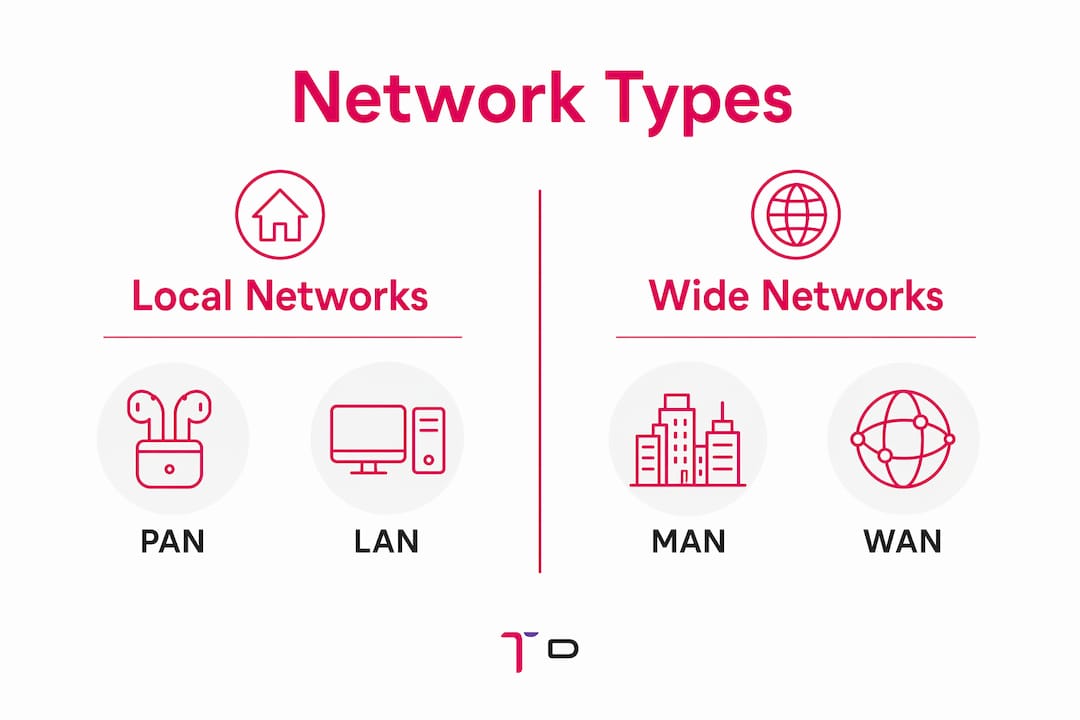
Four primary types of network infrastructure exist, defined by geographic scope: Personal Area Network (PAN), Local Area Network (LAN), Metropolitan Area Network (MAN), and Wide Area Network (WAN). Most businesses operate a combination of these types, often extended with VPN and cloud connectivity to support hybrid work environments.
| Type | Scope | Typical Use Case | Common Technology |
|---|---|---|---|
| PAN | Personal device range | Connecting a laptop to a phone | Bluetooth, USB |
| LAN | Single office or building | Internal office network | Ethernet, Wi-Fi |
| MAN | City or campus | Connecting multiple office locations | Fiber, Metro Ethernet |
| WAN | Regional or global | Linking branch offices across states | MPLS, broadband, SD-WAN |
LAN is the most common type for small and mid-sized businesses. It covers a single office or building and relies on Ethernet switches and Wi-Fi access points. WAN becomes necessary when a business operates across multiple locations or needs reliable access to cloud platforms and remote workers.
Businesses deploying hybrid networks combine LAN at each site with WAN or VPN tunnels connecting them. This approach gives employees consistent access to shared resources regardless of location. Cloud services integration extends this further by hosting applications and storage off-premises.
Pro Tip: If your team works across multiple sites or remotely, map your network type before purchasing hardware. A LAN solution will not solve a WAN problem.
Why does network infrastructure matter for business performance?
Effective network infrastructure reduces downtime, improves communication, and strengthens security. These three outcomes connect directly to business productivity and cost control. A network outage does not just interrupt IT. It stops sales, delays customer service, and blocks access to critical data.
The business benefits of well-designed network infrastructure include:
-
Reduced downtime: Reliable hardware and proactive monitoring prevent unplanned outages.
-
Faster internal communication: High-speed LAN and cloud connectivity support real-time collaboration tools and video conferencing.
-
Stronger data security: Firewalls, intrusion detection systems, and access controls protect sensitive business data.
-
Support for growth: A properly designed infrastructure supports cloud computing, AI tools, and real-time collaboration without requiring a full rebuild.
-
Cost predictability: Planned maintenance and lifecycle management reduce emergency repair costs.
A properly designed infrastructure supports cloud computing, AI, and real-time collaboration, delivering faster and more secure enterprise environments. That means your technology investments compound over time rather than requiring constant emergency spending.
Security deserves special attention. Security must be embedded at the foundation of network infrastructure design, adopting Zero Trust principles rather than relying on legacy perimeter defenses. Zero Trust means no device or user is trusted by default, even inside the network. Every access request is verified. This model is now the standard for organizations serious about protecting data.
“Legacy perimeter-only approaches are insufficient for today’s threat environments. Zero Trust integrates firewalls and access management at the core of infrastructure design, not as an afterthought.”
Pro Tip: Review your cybersecurity posture alongside any network upgrade. Adding new hardware without updating security policies creates new vulnerabilities.
How does network infrastructure lifecycle management work?
Network infrastructure is not a static asset. Viewing it as a dynamic asset through IT Service Management (ITSM) practices prevents performance degradation and maintains business continuity. Organizations that treat their network as a one-time installation consistently face avoidable outages and security gaps.
End-of-life hardware replacement typically occurs every 5–7 years. Failure to replace aging equipment exposes business networks to cybersecurity vulnerabilities and performance bottlenecks. An unsupported router or switch no longer receives security patches, making it a direct entry point for attackers.
Human error accounts for 60–80% of network outages. Software-defined networking (SDN) and automated management tools reduce this risk significantly. Automation removes manual configuration steps that introduce mistakes, and SDN platforms give IT teams centralized visibility over the entire network.
Network infrastructure lifecycle management best practices:
-
Maintain a complete asset inventory. Document every device, its age, firmware version, and support status. You cannot manage what you cannot see.
-
Schedule hardware replacement cycles. Plan replacements on a 5–7 year cycle to stay ahead of end-of-life dates and budget accordingly.
-
Implement automated monitoring tools. Use platforms that alert your team to performance issues before they cause outages.
-
Adopt SDN where possible. Software-defined networking reduces manual configuration errors and gives IT teams centralized control.
-
Test your network regularly. Conduct quarterly performance reviews and annual security audits to identify gaps before they become incidents.
-
Document all changes. Every configuration change should be logged. Undocumented changes are a leading cause of troubleshooting delays.
Professional installation and design lower downtime risk and enable networks that grow with the business. Engaging expert network support for lifecycle planning is one of the most cost-effective decisions a business can make.
Pro Tip: Build your hardware replacement budget into your annual IT plan. Treating network upgrades as capital expenses rather than surprise costs gives finance teams predictability and gives IT teams time to plan properly.
Key Takeaways
Network infrastructure is the foundation of every digital business operation, and managing it proactively determines whether your technology supports or limits your growth.
| Point | Details |
|---|---|
| Three-layer definition | Network infrastructure combines hardware, software, and services to enable secure data flow. |
| Four network types | PAN, LAN, MAN, and WAN each serve different scopes; most businesses use a combination. |
| Security by design | Zero Trust architecture must be built into infrastructure from the start, not added later. |
| Lifecycle management | Replace hardware every 5–7 years and use automated tools to reduce human error and outages. |
| Strategic investment | Treating network infrastructure as a dynamic asset improves continuity and controls long-term costs. |
The case for treating your network as a business asset
From working with businesses across Long Island, the pattern is consistent. Organizations that underinvest in network infrastructure do not realize the cost until something breaks. By then, the damage is done: lost productivity, a security incident, or an emergency replacement that costs three times what a planned upgrade would have.
The most common mistake is treating the network as a utility, like electricity. You flip the switch and expect it to work. But unlike electricity, your network requires active management, regular updates, and deliberate design decisions. When those decisions are deferred, the network quietly degrades. Employees notice slowdowns. IT teams spend more time firefighting. Security gaps widen.
The organizations that get this right do one thing differently. They include IT leadership in business planning conversations. Network capacity decisions should follow business growth plans, not react to them. If you are adding 20 employees or moving to a new office, your network design conversation should happen before the lease is signed, not after the first day of operations.
Zero Trust is another area where I see businesses fall behind. Many still operate with flat networks where a single compromised device can reach everything. The shift to Zero Trust is not a luxury. It is the baseline expectation for any organization handling customer data, financial records, or regulated information.
The good news is that proactive lifecycle management is not complicated. It requires discipline, documentation, and a clear replacement schedule. Businesses that commit to this approach spend less over time and experience far fewer disruptions.
— TechTrone Team
How Techtrone IT Services supports your network infrastructure
Techtrone IT Services works with Long Island businesses to design, manage, and maintain network infrastructure that supports real operational demands.
From structured cabling installation to 24/7 proactive monitoring, Techtrone IT Services delivers the full range of network support that keeps your business running without interruption. The team specializes in network design, hardware lifecycle planning, cloud integration, and cybersecurity, giving you a single partner for your entire IT environment. Whether you are building a new office network or modernizing an aging infrastructure, managed IT services from Techtrone IT Services give you expert oversight and around-the-clock support. Contact Techtrone IT Services today to schedule a free IT assessment and find out exactly where your network stands.
FAQ
What is the network infrastructure definition?
Network infrastructure is the combination of hardware, software, and services that enables data communication across an organization’s networks. It includes routers, switches, firewalls, cabling, management software, and cloud connectivity.
What are the main types of network infrastructure?
The four primary types are PAN, LAN, MAN, and WAN, defined by geographic scope. Most businesses use LAN for internal office connectivity and WAN or VPN to connect multiple locations or remote workers.
How does network infrastructure affect business security?
Network infrastructure is the first line of defense against cyber threats. Modern best practices require embedding Zero Trust architecture and firewall controls at the infrastructure level, not relying on perimeter defenses alone.
How often should network hardware be replaced?
Hardware should be replaced on a 5–7 year cycle. End-of-life devices no longer receive security patches, which creates direct vulnerabilities and performance bottlenecks in your network.
What is the biggest risk of neglecting network infrastructure management?
Human error causes 60–80% of network outages, and unmanaged infrastructure amplifies that risk. Automated monitoring tools and SDN platforms reduce this exposure by removing manual configuration steps and providing real-time visibility.