Scale Cloud Storage for a Growing Business in 2026
By TechTrone Team — Published 2026-06-24
Scale Cloud Storage for a Growing Business in 2026
TL;DR:
- Scalable cloud storage enables on-demand expansion without hardware upgrades or disruptive migrations, supporting business growth. Effective cost management, governance, and architecture selection are critical to prevent unforeseen expenses and security risks as data needs increase. AI workloads further demand high concurrency and high-throughput storage solutions designed for performance and durability.
Scalable cloud storage is defined as on-demand data infrastructure that expands capacity, throughput, and access controls without requiring physical hardware upgrades or disruptive migrations. If you need to scale cloud storage for a growing business, the decisions you make now about architecture, pricing, and governance will determine whether your storage costs stay predictable or spiral out of control. Solutions like Backblaze B2, Scality ADI, and unified governance platforms like Fylioo represent the current standard for businesses that want growth without cost surprises. This guide covers the practical strategies, cost traps, and governance steps that matter most in 2026.
How scalable cloud storage solutions adapt to growing data needs
Object storage is the architecture most suited to business growth. Unlike traditional file systems, object storage uses a flat address space accessible via API, which removes the complex hierarchies and disruptive migrations that slow down growing businesses. You add capacity by adding nodes, not by restructuring your entire storage environment.
Software-defined, autonomous storage models take this further. Autonomous storage infrastructure decouples capacity growth from compute and throughput scaling, so you can expand storage independently without paying for resources you do not need. Scality ADI, for example, aligns storage media, performance, and data protection to each stage of the data lifecycle. That means a video archive does not consume the same resources as a live transaction database.
The practical benefit is the elimination of forklift migrations. A forklift migration means taking your entire storage environment offline to move data to a new system. With horizontal object storage, you scale incrementally. New capacity joins the existing pool without downtime or complex reconfiguration.
Pro Tip: When evaluating storage providers, ask specifically whether capacity, throughput, and operations can each be scaled independently. If the answer is no, you will eventually pay for resources you do not need just to get the capacity you do.
What does cloud storage actually cost when you scale?
Cost is where most businesses get caught off guard. Nearly 50% of hyperscaler cloud storage costs come from variable fees like egress and API requests, not actual storage capacity. That means your bill can double even if your stored data volume stays flat, simply because your applications read data more frequently.
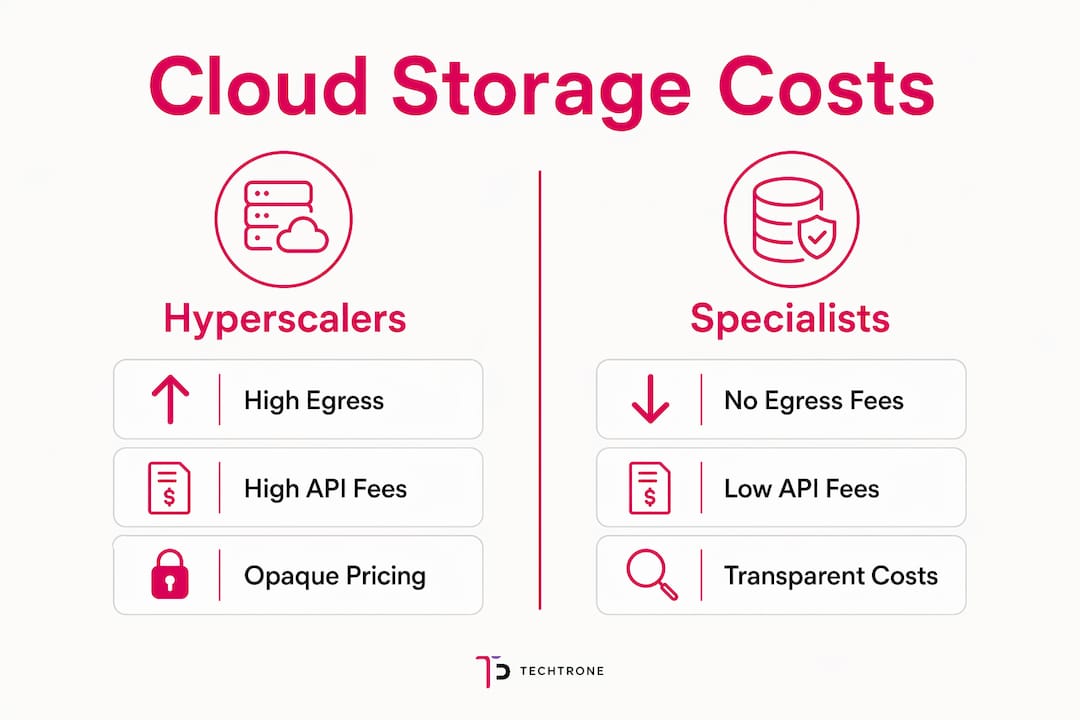
Specialized providers address this directly. Providers like Wasabi offer zero egress and no API request fees, which can cut total storage costs up to 80% compared to hyperscalers like AWS S3, Microsoft Azure Blob Storage, or Google Cloud Storage. For businesses running media-heavy workflows or AI pipelines, that difference is significant.
Here are the most effective cost-saving tactics for businesses scaling cloud storage:
-
Monitor usage by category. Separate costs for capacity, egress, and API calls so you know exactly what is driving your bill.
-
Select fixed or transparent pricing. Providers with predictable monthly rates eliminate budget surprises as data volumes grow.
-
Use tiered storage. Move infrequently accessed data to lower-cost storage tiers automatically using lifecycle policies.
-
Audit access patterns. Unnecessary data retrieval from cloud storage is one of the fastest ways to inflate costs.
-
Negotiate egress fees. If you are committed to a hyperscaler, negotiate egress rates as part of your enterprise agreement.
The table below summarizes the key pricing differences between major hyperscalers and specialist providers:
| Feature | Hyperscalers (AWS, Azure, GCP) | Specialist Providers (Wasabi, Backblaze B2) |
|---|---|---|
| Egress fees | Yes, per GB | None or minimal |
| API request charges | Yes, per request | None or included |
| Cost vs. hyperscalers | Baseline | Up to 80% lower |
| Pricing predictability | Variable | Fixed monthly rate |
| Best for | Broad cloud ecosystem | Storage-heavy workloads |
Why governance and security can’t be an afterthought
Cloud storage is now a core business asset that directly affects financial results and cybersecurity posture. Treating it purely as an IT utility is one of the most common and costly mistakes growing businesses make.
Fragmented storage access creates real operational risk. When different teams use separate cloud accounts with no unified oversight, you end up with multiple dashboards, manual file transfers, unclear data ownership, and rising costs with no visibility into why. That is not a minor inconvenience. It is a compliance and security exposure.
Unified platforms like Fylioo address this by centralizing management across AWS, Azure, and Google Cloud. They enforce access policies, maintain audit logs, and make storage costs predictable. The result is storage that a CFO can budget for and a compliance officer can audit.
Follow these governance steps as your business scales:
-
Assign data ownership. Every storage bucket or container should have a named owner responsible for access and cost.
-
Enforce least-privilege access. Users and applications should access only the data they need, nothing more.
-
Implement audit logging. Every access event should be recorded and reviewable for compliance and incident response.
-
Set cost alerts. Configure billing alerts at defined thresholds so cost spikes are caught before they become budget problems.
-
Review access policies quarterly. Permissions drift over time. A quarterly review catches orphaned accounts and over-provisioned roles.
-
Document your data classification. Know which data is sensitive, which is public, and which is subject to regulatory requirements like HIPAA or SOC 2.
For businesses that need deeper security guidance, reviewing cybersecurity best practices for SMBs alongside your storage governance plan is a practical starting point.
How AI workloads are changing cloud storage demands
AI is reshaping what businesses need from storage infrastructure. 76% growth in AI-related cloud storage customers was recorded in 2026, with one in three new bookings linked to AI workloads. That growth is not slowing down, and it changes the performance requirements for storage significantly.

AI pipelines require high concurrency, meaning many processes reading and writing data simultaneously. They also require GPU-direct throughput, where storage must deliver data fast enough to keep GPU clusters busy. Standard object storage configurations built for archival or backup use cases cannot meet these demands without modification.
Scality ADI is designed specifically for this environment. It enables AI pipelines to operate at needed speed and access patterns without expensive overprovisioning. The architecture supports long-term data durability alongside the high-throughput access that training and inference workloads require.
The shift toward multi-provider “Neocloud” models is also worth noting. Businesses are increasingly distributing workloads across specialized providers rather than relying on a single hyperscaler. Backblaze B2 connects directly with GPU providers, which reduces latency and egress costs for AI-heavy operations.
Pro Tip: If you are planning to run AI workloads within the next 12 months, select a storage provider that explicitly supports high-concurrency access and GPU-direct connectivity. Retrofitting storage infrastructure after an AI deployment is significantly more expensive than planning for it upfront.
Step-by-step guide to scaling cloud storage as your business grows
Scaling storage effectively requires a structured approach. The table below outlines the key decision points and trade-offs at each stage:
| Stage | Action | Key Trade-off |
|---|---|---|
| Baseline assessment | Estimate current data volume and 12-month growth rate | Accuracy vs. time investment |
| Provider selection | Compare hyperscalers vs. specialist providers on total cost | Ecosystem breadth vs. cost efficiency |
| Architecture choice | Choose object storage for horizontal scale | Simplicity vs. legacy system compatibility |
| Governance setup | Implement unified management and access policies | Control vs. team autonomy |
| Cost monitoring | Set billing alerts and review monthly | Visibility vs. administrative overhead |
| AI readiness | Evaluate throughput and concurrency requirements | Performance vs. upfront investment |
Start with a baseline assessment. Estimate your current data volume, how fast it is growing, and how frequently different data sets are accessed. Retrieval frequency determines whether you need hot, warm, or cold storage tiers.
Next, evaluate providers against your total cost of ownership, not just storage capacity pricing. Factor in egress, API calls, and support costs. Then select an architecture. Object storage with horizontal scalability is the right choice for most growing businesses. It removes migration risk and supports incremental expansion.
Once your architecture is in place, implement governance before you scale further. Unified governance platforms make cost predictable and keep your storage environment audit-ready. A solid backup and recovery plan should run in parallel with your governance setup to protect against data loss during transitions.
The most common pitfall is delaying governance until after scaling. Businesses that scale first and govern later spend significantly more time and money cleaning up access sprawl and cost overruns.
Key takeaways
Businesses that treat cloud storage as a strategic asset from the start avoid the cost overruns, security gaps, and operational chaos that come from scaling without a plan.
| Point | Details |
|---|---|
| Object storage enables true scale | Horizontal scaling via API removes migration risk and supports unlimited growth. |
| Variable fees drive hyperscaler costs | Up to 50% of hyperscaler bills come from egress and API charges, not capacity. |
| Specialist providers cut costs sharply | Providers like Wasabi and Backblaze B2 can reduce total storage costs by up to 80%. |
| Governance must precede scale | Unified platforms like Fylioo prevent access sprawl and keep costs predictable. |
| AI workloads demand new infrastructure | High-concurrency, GPU-direct storage is required for AI pipelines in 2026. |
What most businesses get wrong about cloud storage
From working with businesses across Long Island on their cloud infrastructure, the pattern we see most often is this: companies scale their storage reactively. They add capacity when they run out of space, switch providers when bills get too high, and implement governance only after a compliance audit forces the issue. Every one of those decisions costs more than it would have if made proactively.
The uncomfortable truth is that cloud storage pricing is designed to be opaque. Hyperscalers benefit when you do not fully understand egress fees, API request charges, and data retrieval costs. Businesses that read only the headline storage price and miss the variable fee structure routinely end up paying two to three times what they expected.
The shift we encourage is treating cloud storage the same way you treat any other major business expense: with a budget, an owner, and a quarterly review. That is not an IT task. It is a financial management discipline. The businesses that get this right early have a measurable cost advantage over competitors who are still reacting to surprise bills.
AI is accelerating this urgency. With 33% of new cloud storage bookings now linked to AI workloads, the infrastructure decisions you make today will determine whether your AI initiatives are cost-effective or prohibitively expensive. The time to build the right foundation is before the workload arrives, not after.
— TechTrone Team
How techtrone IT services helps you scale storage confidently
Growing businesses on Long Island need more than a storage vendor. They need a partner who understands the full picture: architecture, cost management, governance, and security.
Techtrone IT Services provides managed cloud infrastructure support that covers cloud migration planning, provider selection, cost optimization, and governance implementation. Whether you are moving off a legacy system, evaluating object storage for the first time, or preparing your infrastructure for AI workloads, the team at Techtrone IT Services brings the technical depth and business context to get it right. Explore managed IT services designed specifically for growing businesses that need reliable, cost-controlled cloud storage without the guesswork.
FAQ
What is scalable cloud storage for a growing business?
Scalable cloud storage is infrastructure that expands capacity, performance, and access controls on demand without requiring hardware upgrades or disruptive migrations. Object storage architectures like those used by Backblaze B2 and Scality ADI are the most common implementation for growing businesses.
Why are hyperscaler cloud storage bills so unpredictable?
Nearly 50% of hyperscaler storage costs come from variable fees like egress and API requests, not actual storage capacity. Businesses that monitor only raw storage volume routinely underestimate their total cloud storage expenses.
How much can a business save by switching to a specialist storage provider?
Specialist providers that eliminate egress and API request fees can reduce total cloud storage costs by up to 80% compared to hyperscalers like AWS S3 or Azure Blob Storage. The savings are most significant for businesses with AI, media, or high-retrieval workloads.
When should a growing business implement cloud storage governance?
Governance should be implemented before scaling, not after. Fragmented access models create unpredictable costs, unclear data ownership, and compliance exposure that become significantly harder to resolve once storage volumes grow.
How do AI workloads change cloud storage requirements?
AI pipelines require high-concurrency access and GPU-direct throughput that standard archival storage configurations cannot support. Platforms like Scality ADI are designed to meet these demands without expensive overprovisioning.