IT Compliance Management: A Guide for Business Leaders
By TechTrone Team — Published 2026-06-15
IT Compliance Management: A Guide for Business Leaders
IT compliance management is the structured, continuous process by which organizations identify applicable regulations, implement controls, and maintain ongoing adherence to IT-related legal and security requirements. For business leaders, this is not a back-office function. It is a core operational discipline that protects revenue, customer trust, and the ability to operate. Frameworks like GDPR, HIPAA, SOC 2, and ISO 27001 define the rules. Your compliance management system determines whether you meet them. This guide breaks down what that system looks like, why it matters, and how to build one that actually works.
What is IT compliance management?
IT compliance management is the formal system through which an organization aligns its technology operations with applicable regulatory frameworks including GDPR, HIPAA, SOC 2, ISO 27001, and PCI DSS. The industry term for this system is a Compliance Management System, or CMS. The CMS covers everything from written policies and employee training to technical controls, audit logs, and vendor agreements.
The distinction between IT compliance and general compliance matters here. IT compliance focuses specifically on how data is stored, accessed, transmitted, and protected within your technology environment. A healthcare organization must meet HIPAA requirements for electronic health records. A retailer processing card payments must satisfy PCI DSS controls. A SaaS company serving European customers must comply with GDPR. The applicable frameworks depend on your industry, geography, and the type of data you handle.
Compliance management is not a one-time project. Continuous monitoring and ongoing documentation are what separate organizations that pass audits from those that scramble before them.
What are the main IT regulatory frameworks and standards?
The five frameworks that appear most frequently in IT compliance programs are GDPR, HIPAA, SOC 2, PCI DSS, and ISO 27001. Each addresses a different risk domain, and many organizations must satisfy more than one simultaneously.
| Framework | Primary Focus | Who It Applies To |
|---|---|---|
| GDPR | Personal data privacy and protection | Organizations handling EU resident data |
| HIPAA | Protected health information security | Healthcare providers and their vendors |
| SOC 2 | Security, availability, and confidentiality controls | Technology and SaaS companies |
| PCI DSS | Payment card data security | Any entity processing card transactions |
| ISO 27001 | Information security management systems | Organizations of any size or sector |
These frameworks overlap in meaningful ways. GDPR and ISO 27001 both require documented risk assessments and incident response plans. HIPAA and SOC 2 both demand access controls and audit trails. Building your CMS around ISO 27001 often creates a strong foundation for meeting requirements under the other frameworks as well.
To identify which frameworks apply to your organization, consider three factors: the legal jurisdiction of your customers, the industry you operate in, and any contractual obligations with clients or partners. Many enterprise contracts now require SOC 2 Type II reports as a condition of doing business. Identifying these requirements early prevents costly retrofitting later.
-
Legal requirements: GDPR applies by geography. HIPAA applies by industry.
-
Industry standards: PCI DSS applies to any business accepting card payments, regardless of size.
-
Contractual standards: SOC 2 is increasingly required by enterprise buyers as a vendor qualification.
How does an effective IT compliance management system work?
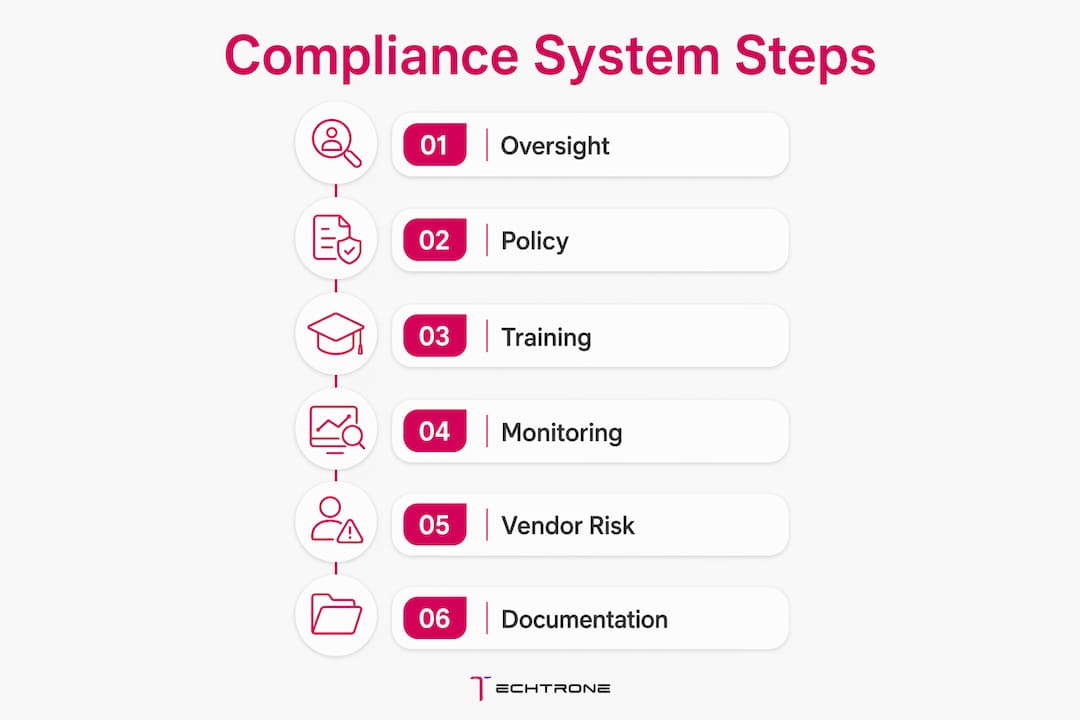
A functioning CMS is built on six interconnected components. Each one depends on the others. Weakness in any single area creates gaps that regulators and auditors will find.
1. Board and management oversight
Board-level oversight is the foundational element of any CMS. Senior leadership sets the tone for how seriously the organization treats compliance. When executives treat compliance as a priority, employees follow. When leadership is disengaged, policies become paper documents that no one enforces.
2. Policy development and integration

Policies must be written, approved, and embedded into daily operations. A policy that exists only in a shared drive is not a working control. Policies need to be tied to specific job roles, reviewed annually, and updated when regulations change.
3. Role-based employee training
Role-specific training is a non-negotiable component of any CMS. A finance employee needs different compliance training than a developer or a customer service representative. Generic annual training does not satisfy most frameworks and does not change behavior.
4. Continuous monitoring and audit functions
Audits alone are not enough. Daily compliance monitoring gives organizations real-time visibility into whether controls are working. Monitoring tools track access logs, configuration changes, and policy violations as they happen, not six months later during an annual review.
5. Third-party and vendor risk management
Your compliance posture is only as strong as your weakest vendor. If a cloud provider or software vendor mishandles data covered by your compliance obligations, your organization bears the regulatory risk. Vendor agreements must include compliance requirements, and vendor controls must be reviewed regularly.
6. Documentation and evidence collection
Regulators and auditors require evidence, not assertions. Every control must be documented with logs, screenshots, policy sign-offs, and training records. Automated evidence collection tools, including platforms like Rippling IT, reduce the manual burden significantly and make audit preparation a continuous process rather than a crisis.
Pro Tip: Set up automated evidence collection from day one. Retroactively gathering documentation before an audit is one of the most common and avoidable compliance failures organizations face.
Why is IT compliance management critical for business success?
The financial consequences of non-compliance are concrete and severe. GDPR fines have totaled €7.1 billion since enforcement began. That figure represents real penalties paid by real organizations that failed to meet requirements they were aware of. The average cost of a global data breach reached $4.88 million in 2024. These numbers make the cost of building a proper CMS look modest by comparison.
Beyond fines, non-compliance causes lost contracts, reputational damage, and regulatory enforcement actions that can disrupt operations for months. Enterprise buyers now conduct compliance due diligence before signing vendor agreements. A missing SOC 2 report or an unresolved HIPAA gap can cost you a deal that took a year to develop.
Organizations that prioritize digital trust through compliance experience annual growth exceeding 10% on revenues and profitability. Compliance is not just risk avoidance. It is a growth driver.
A mature CMS also changes how regulators treat your organization when problems arise. A well-documented compliance program is one of the first things regulators evaluate during an investigation. Organizations with strong programs consistently receive more favorable outcomes, including reduced penalties and faster resolution. That is a direct financial benefit from investing in compliance infrastructure before an incident occurs.
Cyber insurance is another area where compliance pays off. Insurers now require evidence of security controls as a condition of coverage. Organizations without documented compliance programs face higher premiums or outright denial of coverage. You can learn more about this risk in Techtrone’s breakdown of why cyber insurance matters for businesses in 2026.
What practical steps can organizations take to manage IT compliance?
Building and maintaining a CMS requires a structured approach. The following steps reflect how organizations that succeed at compliance actually operate.
-
Conduct a compliance risk assessment. Map your data flows, identify applicable frameworks, and document current gaps. A cybersecurity risk assessment is the right starting point for most small and mid-sized businesses.
-
Select and prioritize your frameworks. Start with the frameworks that carry the highest legal or contractual obligation. Build toward broader coverage over time.
-
Develop written policies and procedures. Policies must be specific, role-assigned, and version-controlled. Vague policies create audit exposure.
-
Deploy compliance automation tools. Platforms that automate identity governance, such as automated identity governance tools, continuously monitor SaaS app permissions and enforce least-privilege access without manual intervention. This reduces insider risk and audit preparation time.
-
Run ongoing training programs. Schedule role-based training at onboarding and at least annually. Track completion rates and document them as evidence.
-
Schedule regular audits and remediate findings. Treat audit findings as a prioritized work queue, not a report to file away. Unresolved findings from prior audits are a red flag for regulators.
-
Manage third-party compliance risks. Require vendors to provide compliance certifications, review their controls annually, and include compliance obligations in every contract.
The two most common failure points in compliance programs are leadership disengagement and documentation gaps. Visible senior management support and a culture where employees feel safe reporting compliance concerns are what separate programs that work from programs that look good on paper.
Pro Tip: Treat your IT compliance checklist as a living document. Review it quarterly and update it whenever a new regulation, vendor, or technology is added to your environment.
Compliance best practices for SMBs from Techtrone offer additional guidance on building security controls that align with common IT regulatory requirements.
Techtrone’s take: compliance is a culture problem before it’s a technology problem
After working with businesses across Long Island on their IT environments, the pattern is consistent. Organizations that struggle with compliance are not usually missing the right software. They are missing leadership commitment and daily operational discipline.
The technology side of compliance has become more manageable. Automation tools handle evidence collection, access reviews, and policy enforcement at a scale that was impossible five years ago. What automation cannot fix is a leadership team that treats compliance as someone else’s problem or a workforce that has never been trained on why these requirements exist.
The organizations that handle compliance well share one trait: they treat it as an ongoing operational practice, not a pre-audit scramble. They monitor controls daily. They update policies when their environment changes. They hold vendors accountable. And when regulators come knocking, they have the documentation to show exactly what they did and when.
Cloud and SaaS environments have made vendor risk management more complex than most organizations realize. Every new SaaS application your team adopts is a potential compliance gap if it is not reviewed against your applicable frameworks. The organizations that stay ahead of this problem build vendor review into their procurement process, not as an afterthought.
The honest advice: start with your highest-risk framework, build your documentation habits early, and get leadership visibly involved. Everything else follows from those three decisions.
— TechTrone
How Techtrone supports your IT compliance program
Maintaining IT compliance requires more than good intentions. It requires consistent monitoring, documented controls, and expert support when gaps appear.
Techtrone’s managed IT services are built to help Long Island businesses meet their compliance obligations without building an internal compliance team from scratch. Techtrone provides 24/7 monitoring, cybersecurity controls, and proactive infrastructure management that align with frameworks including HIPAA, SOC 2, and PCI DSS. Whether you are preparing for your first audit or maintaining an existing compliance program, Techtrone acts as your strategic IT partner. Contact Techtrone today to schedule a free assessment and find out where your compliance program stands.
FAQ
What is IT compliance management in simple terms?
IT compliance management is the ongoing process of ensuring your organization’s technology systems and data practices meet applicable laws, regulations, and industry standards. It includes written policies, employee training, technical controls, and regular audits.
Which IT compliance frameworks apply to most businesses?
The most commonly applicable frameworks are GDPR, HIPAA, SOC 2, PCI DSS, and ISO 27001. The specific frameworks that apply to your organization depend on your industry, the type of data you handle, and your customers’ geographic locations.
What happens if a business fails to meet IT compliance requirements?
Non-compliance consequences include regulatory fines, lost contracts, reputational damage, and enforcement actions. GDPR alone has issued cumulative fines totaling €7.1 billion since enforcement began.
How often should an organization review its IT compliance program?
Compliance controls should be monitored continuously, with formal audits conducted at least annually. Policies and risk assessments should be reviewed whenever a significant change occurs in your technology environment, vendor relationships, or applicable regulations.
Can small businesses realistically manage IT compliance?
Yes. Small businesses can build effective compliance programs by starting with their highest-priority framework, using automation tools to reduce manual work, and partnering with a managed IT service provider that has compliance expertise. The key is treating compliance as a daily operational practice rather than a periodic project.
Key takeaways
Effective IT compliance management requires continuous monitoring, documented controls, and visible leadership commitment, not just annual audits.
| Point | Details |
|---|---|
| Define your applicable frameworks | Identify which of GDPR, HIPAA, SOC 2, PCI DSS, or ISO 27001 apply based on your industry and data types. |
| Build a formal CMS | A Compliance Management System must include board oversight, written policies, role-based training, and audit documentation. |
| Monitor daily, not just annually | Continuous monitoring catches policy violations in real time; audits alone leave dangerous visibility gaps. |
| Manage vendor compliance risk | Third-party vendors can inherit compliance failures to your organization if their controls are not reviewed and contractually required. |
| Compliance drives business growth | Organizations prioritizing digital trust through compliance report annual growth exceeding 10% on revenues and profitability. |