How to Encrypt Sensitive Business Data Effectively
By TechTrone Team — Published 2026-06-12
How to Encrypt Sensitive Business Data Effectively
Encryption is the process of converting readable data into ciphertext that only authorized parties can decode using a cryptographic key. To encrypt sensitive business data is to apply standards like AES-256 for stored files and TLS 1.3 for data in transit, protecting your organization from breaches and regulatory penalties under GDPR, HIPAA, SOC 2, and PCI DSS. Encryption supports confidentiality and minimizes breach damage even when unauthorized access occurs. Without it, a single compromised server can expose customer records, financial data, and trade secrets in plain text. The right encryption strategy combines the correct algorithms, disciplined key management, and enforceable policies across every system your business operates.
How to identify and classify sensitive business data before encrypting
Encryption decisions must start with a clear inventory of what data you actually hold. You cannot protect what you have not identified, and applying encryption indiscriminately wastes resources while creating performance problems. GDPR Article 32 and NIST guidance both treat data inventory and classification as prerequisites for any encryption deployment.
Sensitive business data generally falls into four categories:
-
Personal data: Names, email addresses, Social Security numbers, and any information that identifies an individual under GDPR or CCPA.
-
Financial records: Bank account details, payment card data governed by PCI DSS, and internal financial statements.
-
Health information: Patient records, insurance data, and any information subject to HIPAA.
-
Trade secrets and intellectual property: Proprietary formulas, source code, client contracts, and strategic plans.
Each category carries a different risk profile and regulatory obligation. A law firm’s client contracts demand the same encryption rigor as a healthcare provider’s patient files, but the applicable compliance standard differs. Once you map your data by type and location, you can apply encryption proportionate to the actual risk rather than blanket every file on every server.
For cloud environments, tools like Microsoft Purview and AWS Macie automate data discovery and apply sensitivity labels across SharePoint, OneDrive, and S3 buckets. On-premise systems require manual tagging workflows or dedicated data loss prevention platforms. Either way, the classification output should feed directly into your encryption policy so that high-sensitivity labels trigger automatic encryption controls.
Pro Tip: Automate classification with a data governance platform like Microsoft Purview or Varonis. These tools scan file contents, apply sensitivity labels, and feed classification results directly into your encryption and access control policies, removing the manual burden from your IT team.
What are the best encryption methods for sensitive business data?
Choosing the right method depends on whether data is at rest, in transit, or being processed. Each state carries distinct vulnerabilities and calls for a different technical approach.
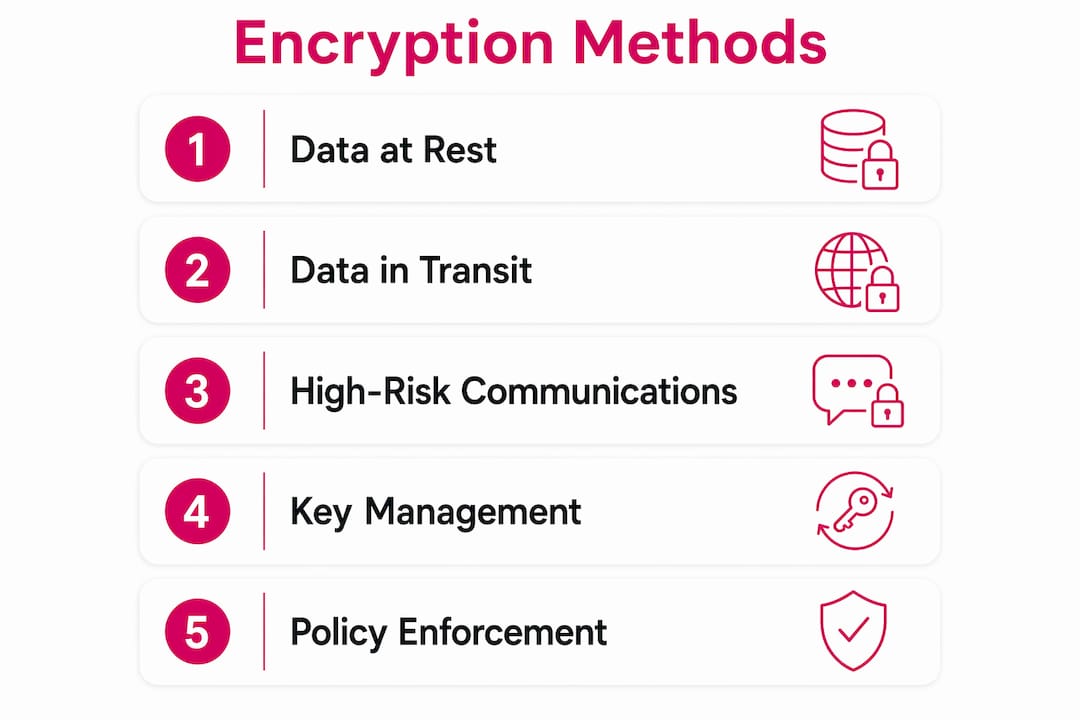
Symmetric encryption for data at rest
AES-256 (Advanced Encryption Standard with a 256-bit key) is the recognized standard for encrypting stored data. It is fast, computationally efficient, and approved by NIST for protecting classified government information. Full-disk encryption tools like BitLocker on Windows and FileVault on macOS use AES-256 to protect laptops and workstations. Database platforms apply it at the column or tablespace level to protect specific sensitive fields without encrypting the entire database.

Oracle’s DBMS_CRYPTO package enables on-demand encryption and decryption using AES directly within database operations, allowing developers to encrypt data at the point of collection and keep it encrypted through subsequent storage layers. This approach is particularly useful when you need to protect specific columns, such as Social Security numbers or credit card fields, without restructuring the entire schema.
Transport layer security for data in transit
TLS 1.2 and TLS 1.3 protect data moving between systems, browsers, APIs, and cloud services. TLS 1.3 is the current standard and eliminates several vulnerabilities present in earlier versions, including weak cipher suites and unnecessary handshake round trips. Any web application, internal API, or SaaS integration that transmits sensitive data must enforce TLS 1.3 and reject connections using older protocols.
End-to-end encryption for high-risk communications
End-to-end encryption protects data along the entire transmission path, meaning only the sender and recipient can read the content. GDPR recommends it as a proportionate measure for high-risk data exchanges. Platforms like ProtonMail and Signal implement end-to-end encryption natively. For business file sharing, solutions like Tresorit and Kiteworks apply it to document transfers and email attachments.
| Method | Use case | Key advantage | Limitation |
|---|---|---|---|
| AES-256 | Data at rest: disks, databases, backups | Fast, NIST-approved, widely supported | Requires secure key storage |
| TLS 1.3 | Data in transit: APIs, web apps, email | Protects live data streams | Does not protect stored data |
| End-to-end encryption | High-risk communications and file transfers | Only sender and recipient can decrypt | Performance overhead on large files |
| Column-level encryption | Database fields with sensitive values | Granular protection, limits admin visibility | Affects indexing and query performance |
Pro Tip: Never rely on a single encryption layer. Combine AES-256 for storage with TLS 1.3 for transmission and column-level encryption for your most sensitive database fields. Defense in depth means a breach at one layer does not expose readable data.
How to manage encryption keys effectively
Key management is the most operationally demanding part of any encryption program. A strong algorithm like AES-256 provides no protection if the encryption key is stored in the same location as the encrypted data, shared across teams, or never rotated. NIST 800-53 control SC-12 requires formal processes covering key creation, distribution, storage, rotation, and destruction across the full key lifecycle.
The most common key management failures in business environments include:
-
Storing encryption keys in application configuration files alongside the data they protect.
-
Using the same key for multiple systems or data types, so a single compromise affects everything.
-
Failing to rotate keys on a defined schedule, leaving long-lived keys exposed to gradual brute-force attacks.
-
Deleting keys without first decrypting the data they protect, causing permanent data loss.
Cloud key management services like Azure Key Vault and AWS KMS address most of these failures through automation. Both platforms support automatic key rotation, hardware-backed key storage, and detailed audit logs that record every key access event. Hardware Security Modules (HSMs) provide the highest level of physical key protection for organizations with strict compliance requirements, such as financial institutions operating under PCI DSS.
Audit logging is not optional. Every key access, rotation event, and permission change must be recorded in an immutable log. This log becomes your primary evidence during a compliance audit or breach investigation.
Pro Tip: Integrate your key management service with your identity and access management platform. Azure Key Vault connects directly to Azure Active Directory, so key access permissions follow the same role-based policies that govern the rest of your environment. This eliminates the risk of orphaned key permissions after employee offboarding.
How to implement encryption policies and enforce compliance
Defining an encryption policy is straightforward. Enforcing it consistently across email, file sharing, cloud storage, and APIs is where most organizations fall short. Policy enforcement requires technical controls that apply automatically, not manual processes that depend on individual employees making the right decision.
Attribute-based access control (ABAC) is the most effective model for dynamic policy enforcement. ABAC evaluates multiple attributes simultaneously, including user role, data classification label, device compliance status, and location, before granting access to encrypted data. This means a contractor accessing your network from an unmanaged device cannot reach encrypted financial records even if they have valid credentials.
Unified audit logging and immutable records change compliance from a reactive exercise into a continuous, provable state. Platforms like Kiteworks apply policy enforcement and immutable logging across email, file transfers, APIs, and web forms from a single control plane. This matters because GDPR, SOC 2, HIPAA, and PCI DSS all require demonstrable evidence that controls were active and effective, not just that they were configured.
Automated enforcement across communication channels should cover:
-
Email: Automatically encrypt outbound messages containing flagged data patterns such as credit card numbers or Social Security numbers.
-
File sharing: Enforce encryption on all files shared externally through platforms like SharePoint or Box.
-
APIs: Require TLS 1.3 on all API endpoints and reject unencrypted connections at the gateway level.
-
Backups: Apply AES-256 to all encrypted backup files before they leave your primary environment.
Encryption paired with real-time policy enforcement and immutable audit logs shifts compliance from reactive proof to proactive governance. That shift is what auditors and regulators are increasingly expecting to see.
Common challenges when implementing encryption for business data
Encryption introduces real operational trade-offs that you need to plan for before deployment, not after.
-
Performance degradation on databases. Column-level encryption affects indexed data and can slow query performance significantly. Test encryption on a staging environment before applying it to production databases, and consider encrypting only the columns that contain regulated data rather than entire tables.
-
Access control conflicts. Encryption must not interfere with legitimate access privileges. Database administrators who need to perform maintenance tasks should not be locked out of systems they manage. Design your key access policies to align with existing role-based access controls rather than creating a parallel permission structure.
-
Key loss scenarios. Losing an encryption key without a recovery mechanism means permanent data loss. Every key management policy must include a documented key recovery process and secure key escrow for critical systems.
-
Algorithm obsolescence. Crypto agility, the ability to update cryptographic algorithms without downtime, is a NIST-recommended design principle. Build your encryption architecture so that swapping from one algorithm to another requires a configuration change, not a full system rebuild.
-
Over-encryption. Encrypting all data indiscriminately, including low-sensitivity public files, creates unnecessary overhead and makes key management unmanageable. Apply encryption based on your classification results, not as a default for every file.
Pro Tip: Use a phased rollout. Start with your highest-risk data categories, such as payment card data and health records, and validate performance and access controls before expanding to lower-sensitivity systems. This limits disruption and gives your team time to refine key management processes.
Key takeaways
Encrypting sensitive business data requires the right algorithms, disciplined key management, and automated policy enforcement working together as a continuous program, not a one-time configuration.
| Point | Details |
|---|---|
| Classify before encrypting | Inventory and label data by sensitivity before selecting encryption methods or deploying controls. |
| Match method to data state | Use AES-256 for data at rest and TLS 1.3 for data in transit; combine both for layered protection. |
| Automate key management | Use Azure Key Vault or AWS KMS to handle rotation, storage, and audit logging without manual processes. |
| Enforce policy automatically | Apply ABAC and unified audit logging so encryption controls are consistent across all channels. |
| Plan for crypto agility | Design your architecture to support algorithm updates without downtime as standards evolve. |
Encryption strategy: what most businesses get wrong
After working with businesses across Long Island on their cybersecurity posture, Techtrone has seen one pattern repeat itself more than any other. Organizations invest in strong encryption algorithms and then neglect the operational discipline that makes those algorithms effective. AES-256 is unbreakable in practice. The keys that unlock it are not.
The businesses that handle this well treat encryption as a continuous program rather than a project with a completion date. They schedule key rotation, review access logs monthly, and test their key recovery procedures before they need them. The businesses that struggle treat encryption as a checkbox. They configure BitLocker, note it in their compliance documentation, and move on. Then a key management failure or an unencrypted backup surfaces during an audit or, worse, a breach.
The other gap Techtrone consistently sees is the disconnect between encryption and broader cybersecurity practices. Encryption protects data at rest and in transit, but it does not stop a compromised credential from accessing encrypted systems through legitimate channels. The organizations with the strongest data protection combine encryption with multi-factor authentication, endpoint detection, and real-time monitoring. Each control compensates for the limitations of the others.
The future pressure point is crypto agility. Post-quantum cryptography standards are advancing, and businesses that have built rigid encryption architectures will face expensive migrations. Building flexibility into your encryption design today is not overcautious. It is the practical choice.
— TechTrone
How Techtrone helps Long Island businesses protect sensitive data
Techtrone’s managed IT and cybersecurity services are built to handle the full encryption lifecycle for businesses that do not have the internal resources to manage it continuously. Techtrone configures and monitors AES-256 and TLS implementations, manages cloud key management integrations with Azure Key Vault and AWS KMS, and maintains audit-ready compliance reporting for GDPR, HIPAA, SOC 2, and PCI DSS requirements.
With 24/7 proactive monitoring and threat response, Techtrone identifies key management failures, unencrypted data exposure, and policy gaps before they become breach events. If your business handles sensitive customer, financial, or health data and you are not confident your encryption program is complete and current, contact Techtrone for a free IT assessment. A tailored encryption strategy built around your specific compliance obligations and data environment is the starting point.
FAQ
What does it mean to encrypt sensitive business data?
Encrypting sensitive business data means converting readable information into ciphertext using a cryptographic algorithm such as AES-256, so that only parties with the correct decryption key can access it. This protects data from unauthorized access during storage, transmission, and processing.
Which encryption standard should businesses use for data at rest?
AES-256 is the NIST-approved standard for encrypting data at rest and is used by platforms including BitLocker, FileVault, and Oracle Database. It provides strong protection for stored files, database columns, and backup archives.
Is encryption alone enough to meet GDPR and HIPAA compliance?
Encryption is a required technical safeguard under both GDPR Article 32 and HIPAA Security Rule, but it must be paired with access controls, audit logging, and documented key management policies to satisfy full compliance requirements.
How often should encryption keys be rotated?
Key rotation frequency depends on the sensitivity of the data and the applicable compliance standard. Most frameworks recommend annual rotation at minimum, while high-sensitivity environments such as payment card systems may require quarterly rotation. Azure Key Vault and AWS KMS both support automatic rotation on a defined schedule.
What happens if an encryption key is lost?
Lost encryption keys without a recovery mechanism result in permanent, unrecoverable data loss. Every key management policy must include a documented recovery process and secure key escrow stored separately from the encrypted data it protects.